California's Energy Requirements for ADUs: What You Need to Know
California leads the nation in building energy efficiency standards, and Accessory Dwelling Units (ADUs) are no exception. If you are planning to build an ADU in California, you need to understand the solar panel mandates, Title 24 energy efficiency requirements, and CalGreen green building standards that apply to your project. These requirements affect your design, budget, and timeline, but they also deliver long-term benefits through reduced energy costs and increased property value.
The rules can be confusing because they have changed several times in recent years, and certain exemptions apply specifically to ADUs. In this comprehensive guide, we will break down exactly which energy requirements apply to your ADU, when solar panels are required, what exemptions are available, the costs involved, and how to optimize your ADU's energy performance for both code compliance and maximum long-term savings.
Title 24 Energy Efficiency Standards
Title 24, Part 6 of the California Building Code establishes minimum energy efficiency standards for all new construction, including ADUs. The California Energy Commission (CEC) updates these standards every three years, with the 2022 code cycle currently in effect through 2025, and the 2025 code cycle taking effect in 2026.
Key Title 24 Requirements for ADUs
| Component | 2022 Code Requirement | 2025 Code Update |
|---|---|---|
| HVAC System | Heat pump baseline | Higher efficiency heat pump |
| Water Heating | Heat pump water heater preferred | Heat pump water heater baseline |
| Insulation (Wall) | R-13 to R-21 (climate dependent) | R-21+ continuous insulation in some zones |
| Insulation (Ceiling) | R-30 to R-38 | R-38 minimum in most zones |
| Windows | U-factor 0.30 or lower | U-factor 0.28 or lower in some zones |
| Lighting | All LED, dimmable | All LED with occupancy sensors |
| Ventilation | ASHRAE 62.2 mechanical ventilation | Enhanced filtration (MERV 13+) |
Your ADU must demonstrate compliance with Title 24 through an energy analysis performed by a certified energy consultant using approved software (such as EnergyPro or CBECC-Res). This analysis, known as a Title 24 energy report, is required as part of your building permit application and typically costs $300 to $800.
Solar Panel Requirements for ADUs
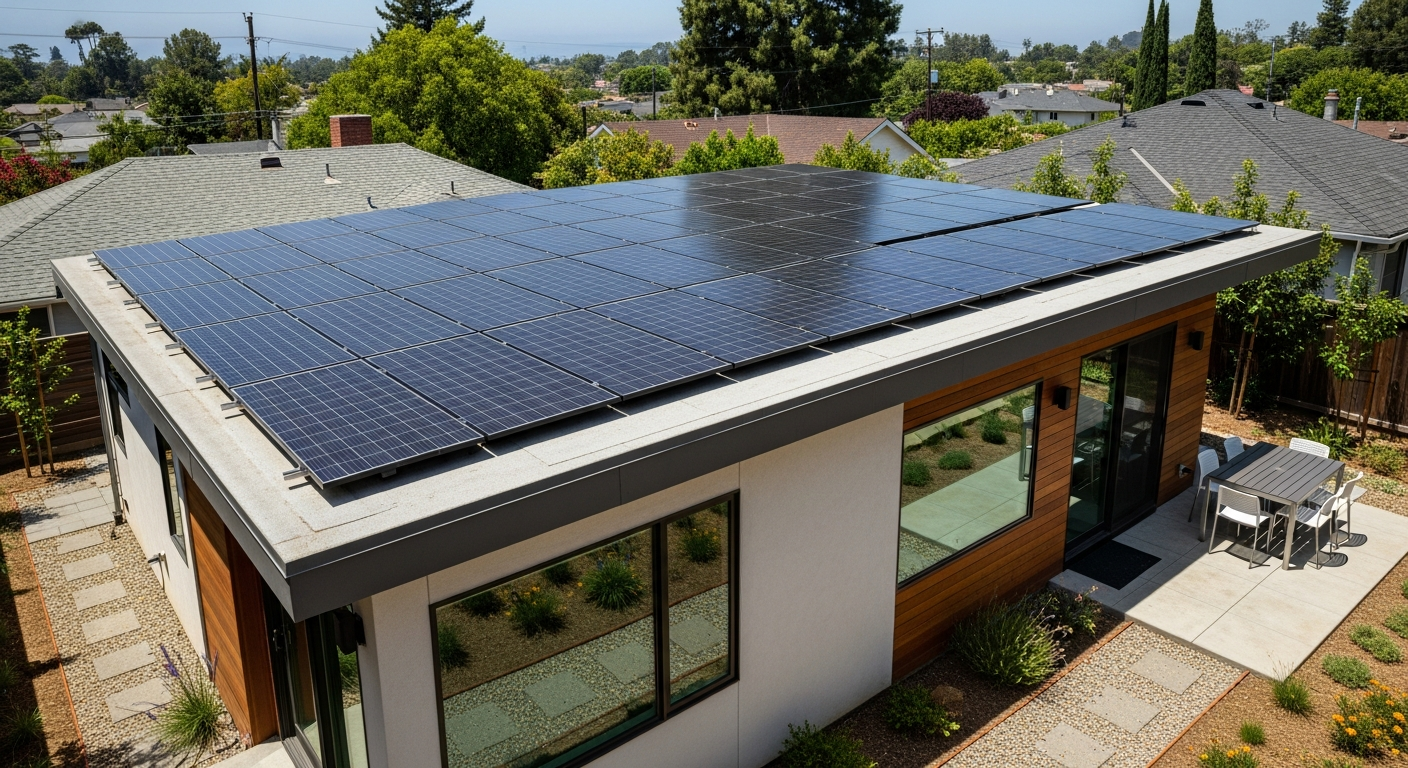
California's solar mandate, which took effect on January 1, 2020, requires solar photovoltaic (PV) systems on most new residential construction. However, the application of this mandate to ADUs has specific nuances that are important to understand.
When Solar Is Required on ADUs
The solar mandate applies to new construction that is classified as a "new dwelling unit" under Title 24. For ADUs, the requirements depend on the type of ADU being built:
| ADU Type | Solar Required? | Notes |
|---|---|---|
| New detached ADU (own roof) | Generally yes | Must have sufficient roof area |
| Garage conversion | May be exempt | Conversion of existing space exemption may apply |
| Attached ADU (using main roof) | Depends on jurisdiction | May be met by main house system |
| JADU (Junior ADU) | Usually exempt | Within existing structure footprint |
| ADU under 400 sq ft | May be exempt | Insufficient roof area exception |
Solar System Sizing for ADUs
When solar is required, the system must be sized to offset the ADU's expected annual energy consumption. For a typical ADU, this means:
| ADU Size | Typical System Size | Estimated Cost |
|---|---|---|
| 400 sq ft | 1.5 to 2.5 kW | $4,000 to $8,000 |
| 600 sq ft | 2.0 to 3.5 kW | $6,000 to $11,000 |
| 800 sq ft | 2.5 to 4.0 kW | $7,500 to $13,000 |
| 1,000 sq ft | 3.0 to 5.0 kW | $9,000 to $16,000 |
| 1,200 sq ft | 3.5 to 6.0 kW | $10,500 to $19,000 |
These costs are before the federal solar Investment Tax Credit (ITC), which currently provides a 30% tax credit on solar installation costs. After the ITC, a $10,000 system effectively costs $7,000.
Wondering What Your ADU Will Cost?
Use our free cost calculator to get an instant estimate for your project.
Try the Cost CalculatorCalGreen Requirements for ADUs
CalGreen (Title 24, Part 11) is California's green building code, which sets mandatory requirements for water efficiency, material conservation, and indoor environmental quality in new construction.
Mandatory CalGreen Requirements for ADUs
- Water efficiency: Low-flow fixtures (toilets at 1.28 gpf, showerheads at 2.0 gpm, faucets at 1.2 gpm), weather-based irrigation controllers
- Material conservation: Minimum 65% construction waste diversion from landfill, use of low-VOC paints, adhesives, and sealants
- Indoor air quality: MERV 13 air filtration for mechanical ventilation, low-VOC interior finishes, bathroom and kitchen exhaust ventilation
- Electric vehicle readiness: Pre-wiring for a Level 2 (240-volt) EV charger at the ADU's designated parking space
- Battery storage readiness: Pre-wiring and panel capacity for future battery storage system installation
Voluntary CalGreen Tiers
CalGreen also includes voluntary Tier 1 and Tier 2 standards that go beyond mandatory requirements. Some cities (such as Marin County and several Bay Area jurisdictions) have adopted Tier 1 or Tier 2 as mandatory, so check your local requirements.
Battery Storage for ADUs
While battery storage is not yet mandatory for most California ADUs, the state is moving toward requiring it, and there are compelling reasons to include it in your project:
Benefits of Battery Storage
- Time-of-use savings: Store solar energy during the day and use it during peak rate periods (4 PM to 9 PM), saving 20% to 40% on electricity costs
- Backup power: Keep your ADU powered during outages (increasingly important with California's public safety power shutoffs)
- NEM 3.0 optimization: Under California's new net energy metering rules, exporting solar to the grid is worth much less than self-consumption. Battery storage maximizes self-consumption and financial returns
- Future-proofing: Battery requirements are likely coming; installing now avoids retrofit costs
Battery Storage Costs
| Battery System | Capacity | Cost (Before ITC) |
|---|---|---|
| Tesla Powerwall | 13.5 kWh | $10,000 to $14,000 |
| Enphase IQ Battery 5P | 5 kWh per unit | $5,000 to $8,000 per unit |
| LG RESU Prime | 16 kWh | $9,000 to $13,000 |
| Franklin WH aPower | 13.6 kWh | $10,000 to $14,000 |
The 30% federal ITC applies to battery storage when installed with solar, reducing effective costs by nearly a third.
Energy Efficiency Strategies Beyond Code Minimum
Meeting code minimums is required, but going beyond minimum standards can pay for itself through energy savings. Here are the most cost-effective energy efficiency upgrades for California ADUs:
High-Performance Envelope
- Continuous exterior insulation: Adding rigid foam insulation outside the framing eliminates thermal bridging and can improve wall performance by 20% to 40%
- Triple-pane windows: While more expensive, triple-pane windows dramatically reduce heat gain in summer and heat loss in winter
- Cool roof: High-reflectance roofing materials reduce cooling loads by 10% to 20%
All-Electric Design
California's 2022 code effectively requires all-electric design for new construction by using heat pumps as the baseline for both space heating and water heating. An all-electric ADU paired with solar panels can achieve net-zero energy consumption, meaning the solar panels generate as much energy as the ADU uses over the course of a year.
Ready to Start Your ADU Project?
Get a free consultation with our ADU experts and discover your property's potential.
Schedule Free ConsultationFrequently Asked Questions
Do all ADUs in California need solar panels?
Not all ADUs require solar panels. Exemptions may apply for garage conversions, JADUs, very small ADUs (under 400 sq ft), and ADUs where shading or roof orientation makes solar impractical. New detached ADUs with their own roof generally do need solar. Check with your energy consultant and local building department for your specific situation.
How much do solar panels add to ADU construction costs?
A solar system for a typical ADU costs $4,000 to $19,000 before the 30% federal tax credit. After the tax credit, expect $2,800 to $13,300. This investment typically pays for itself within 5 to 8 years through reduced electricity costs, making it one of the best long-term investments in your ADU.
Can the main house solar system cover the ADU?
In some cases, yes. If the ADU shares the same electrical meter as the main house, the main house solar system can be sized to cover both. However, if the ADU has a separate meter (which is increasingly common and sometimes required), the ADU needs its own solar system or a documented solar offset strategy.
What is NEM 3.0 and how does it affect my ADU?
Net Energy Metering (NEM) 3.0 is California's current solar billing structure, which significantly reduced the value of solar energy exported to the grid. Under NEM 3.0, you earn roughly $0.04 to $0.08 per kWh for exported energy, compared to $0.20 to $0.40 you pay for grid electricity. This makes battery storage much more valuable because self-consuming your solar energy is worth 3 to 5 times more than exporting it.
Is battery storage required for ADUs in California?
Battery storage is not currently mandatory for most California ADUs, but the 2022 code requires "battery-ready" pre-wiring (a dedicated 240V circuit and breaker space in the electrical panel). Given the direction of California energy policy and the economics of NEM 3.0, installing battery storage during construction is highly recommended.
What are the penalties for not meeting Title 24 requirements?
Non-compliance with Title 24 will prevent you from obtaining building permits and passing final inspections. Without final inspection approval, you cannot legally occupy or rent the ADU. There is no option to "opt out" of Title 24 requirements, so compliance is mandatory.
Browse Our ADU Floor Plans
Explore our collection of pre-designed floor plans from 400 to 1,200 sq ft.
View Floor PlansCost-Benefit Analysis of Solar for California ADUs
Understanding the financial impact of solar energy on your ADU project helps California homeowners make informed decisions about their investment. While California's Title 24 requires solar on most new construction, knowing the long-term economics ensures you maximize the return on this mandated investment.
Upfront Costs of Solar for ADUs
The cost of solar panels for an ADU depends on system size, which is determined by the unit's estimated energy consumption. Here is a breakdown of typical solar costs for California ADUs:
- Small ADU (under 500 sq ft): A 2 to 3 kW system costing $5,000 to $9,000 before incentives typically meets energy requirements
- Medium ADU (500 to 750 sq ft): A 3 to 4 kW system costing $8,000 to $12,000 before incentives provides adequate coverage
- Large ADU (750 to 1,200 sq ft): A 4 to 6 kW system costing $10,000 to $18,000 before incentives addresses higher energy demands
The federal Investment Tax Credit (ITC) currently provides a 30% tax credit on the total cost of solar installation, significantly reducing the net expense. For a $10,000 system, the federal tax credit reduces your out-of-pocket cost to approximately $7,000. Some California utility companies also offer additional rebates for solar installation on new construction.
Long-Term Energy Savings
California electricity rates are among the highest in the nation, averaging $0.25 to $0.40 per kilowatt-hour depending on your utility provider and rate plan. Solar panels on your ADU can offset most or all of the unit's electricity consumption, producing meaningful savings:
- A typical ADU consumes 3,000 to 6,000 kWh per year
- Annual electricity savings range from $750 to $2,400 depending on usage and rates
- Over a 25-year panel lifespan, cumulative savings reach $20,000 to $60,000
- As California electricity rates continue to increase (historically 3-5% annually), savings grow each year
Payback Period Calculation
For most California ADU solar installations, the payback period ranges from 5 to 8 years after applying the federal tax credit. After the payback period, the solar panels generate free electricity for the remaining 17 to 20 years of their expected lifespan. This makes solar one of the highest-return investments in your ADU project, even though it is a mandated requirement rather than an optional upgrade.
Battery Storage Options for ADU Solar Systems
Battery storage systems allow your ADU to store excess solar energy generated during the day for use during evening hours and grid outages. With California's shift from net metering (NEM 2.0) to the less generous net billing tariff (NBT), battery storage has become increasingly valuable for maximizing solar investment returns.
Popular Battery Systems for ADU Applications
Several battery storage options are well-suited for ADU-scale solar systems:
- Tesla Powerwall: The most recognized residential battery with 13.5 kWh capacity, sufficient for most ADU needs. Costs approximately $8,500 to $12,000 installed. Integrates seamlessly with Tesla solar panels and is compatible with third-party solar systems.
- Enphase IQ Battery: Modular design allows you to start with a smaller capacity (3.36 kWh per unit) and add units as needed. Ideal for smaller ADUs where a full-size battery would be oversized. Costs approximately $3,000 to $5,000 per module installed.
- Franklin WholePower: Designed specifically for whole-home backup with a scalable architecture. Offers 13.6 kWh per battery unit. Costs approximately $9,000 to $13,000 installed.
- LG Energy Solution RESU: Compact design that fits in tight spaces common in ADU installations. Available in 9.6 kWh and 16 kWh capacities. Costs approximately $7,000 to $11,000 installed.
When Battery Storage Makes Financial Sense
Battery storage is most financially beneficial for California ADU owners in these situations:
- Time-of-use rate plans: If your utility charges significantly more for electricity during peak evening hours (typically 4 PM to 9 PM), stored solar energy used during these hours offsets the highest-cost electricity
- Net billing tariff (NBT) customers: Under California's new net billing structure, the compensation for exported solar energy is much lower than under previous net metering, making self-consumption through battery storage more valuable
- Areas prone to power outages: Properties in fire-prone areas or regions with frequent PSPS (Public Safety Power Shutoff) events benefit from battery backup for critical systems
- ADUs used as rental units: Battery storage can be marketed as an amenity that differentiates your rental ADU and justifies higher rent
The federal 30% tax credit applies to battery storage systems as well, reducing the effective cost significantly. For a comprehensive look at how solar and energy efficiency affect your overall project, see our guide on energy-efficient ADU design.
Frequently Asked Questions About Solar Energy for California ADUs
Is solar required on all new ADUs in California?
California's Title 24 energy code requires solar photovoltaic systems on most new residential construction, including ADUs. However, there are exceptions. ADUs that are additions to existing structures (such as garage conversions or attached ADUs) may be exempt depending on the scope of work. ADUs where the roof area is too small or shaded to support effective solar may receive an exemption. Your energy consultant or Title 24 compliance specialist will determine whether your specific ADU project requires solar and what size system is needed. Learn more about California ADU costs including solar.
Can I install solar panels on my main home instead of on the ADU?
Yes, in many cases you can install solar panels on your main home's roof to satisfy the ADU's solar requirement, as long as the system generates enough energy to offset both the main home's and the ADU's energy consumption. This approach is often preferred when the main home has better roof orientation for solar (south or west facing) or more unshaded roof area. Your solar installer and Title 24 energy consultant can design a system that meets the combined requirements for both structures.
How many solar panels does an ADU typically need?
A typical ADU requires 6 to 15 solar panels depending on the unit's size, energy consumption, and the wattage of the panels selected. Modern high-efficiency panels produce 370 to 450 watts each. A small 400-square-foot studio ADU might need only 6 to 8 panels, while a larger 1,200-square-foot two-bedroom ADU could require 12 to 15 panels. The exact number is calculated as part of the Title 24 energy compliance report prepared during the design phase.
What happens to excess solar energy my ADU produces?
Under California's current net billing tariff, excess solar energy exported to the grid earns a credit on your electricity bill, but at a significantly lower rate than the retail electricity price. This is why battery storage has become more popular, as storing excess energy for your own use during evening hours provides greater financial benefit than exporting it. If your ADU is rented, you can either include electricity in the rent and benefit from the solar savings directly, or sub-meter the ADU and pass the solar savings to the tenant as a marketing advantage.
Do solar panels add to the resale value of an ADU property?
Yes, studies consistently show that solar panels increase property resale value in California. The National Renewable Energy Laboratory estimates that each kilowatt of solar capacity adds approximately $3,000 to $4,000 in property value. For a typical 4 kW ADU solar system, that translates to $12,000 to $16,000 in added property value, which often exceeds the net cost of the system after tax credits. Buyers in California increasingly expect solar on newer construction, and properties without it may be viewed less favorably. For more on maximizing your ADU investment returns, explore our ROI analysis.