Why Multi-Generational Living Is Thriving in California
Multi-generational living is experiencing a renaissance across California, driven by rising housing costs, an aging population, childcare needs, and cultural traditions that value family closeness. According to the Pew Research Center, roughly 18% of Americans now live in multi-generational households, and that number is significantly higher in California, where housing costs make it difficult for younger and older family members to maintain separate homes.
An Accessory Dwelling Unit (ADU) is the ideal solution for multi-generational living because it provides the perfect balance of togetherness and independence. Family members can live on the same property while maintaining separate living spaces, kitchens, bathrooms, and entrances. The key to a successful multi-generational ADU is thoughtful design that respects both shared time and private space.
In this comprehensive guide, we will explore the best ADU designs for multi-generational families, covering floor plan options, privacy features, shared outdoor spaces, accessibility considerations, and practical tips for making the arrangement work for everyone involved. Whether you are building an ADU for aging parents, adult children, or extended family, you will find design strategies that promote harmony and long-term satisfaction.
Who Benefits from Multi-Generational ADU Living?
Aging Parents
The most common multi-generational ADU arrangement involves aging parents moving into an ADU on their adult children's property (or vice versa). This arrangement provides proximity for caregiving while preserving the parent's independence. Parents benefit from being close to family without feeling like they are "in the way," and adult children benefit from having parents nearby for grandchild care and companionship.
Adult Children
With California's median home price exceeding $800,000 in many markets, many young adults cannot afford to buy their own home. An ADU allows adult children to save money on rent while building financial stability, all while remaining close to family. This arrangement is especially common in Los Angeles, San Jose, San Francisco, and San Diego.
Extended Family
In many cultures, multi-generational living with grandparents, aunts, uncles, or cousins is the norm rather than the exception. ADUs provide a culturally appropriate housing solution that allows extended families to maintain close bonds while respecting the need for separate living spaces.
Families with Caregiving Needs
Families with members who have disabilities, chronic illnesses, or special needs benefit from the proximity and independence that an ADU provides. A caregiver can live in either the main house or the ADU, depending on the specific arrangement that works best for the family.
Browse Our ADU Floor Plans
Explore our collection of pre-designed floor plans from 400 to 1,200 sq ft.
View Floor PlansBest Floor Plans for Multi-Generational ADUs
1. The One-Bedroom Suite (400 to 600 sq ft)
This compact design works well for a single aging parent or individual family member. It includes a bedroom, full bathroom, living area, and kitchenette or full kitchen. Despite its small size, careful design can create a comfortable and private living space.
| Room | Recommended Size | Design Tips |
|---|---|---|
| Bedroom | 120 to 150 sq ft | Include walk-in closet or built-in storage |
| Bathroom | 50 to 70 sq ft | Roll-in shower for accessibility |
| Living/Dining | 150 to 200 sq ft | Open concept with kitchen |
| Kitchen | 60 to 100 sq ft | Full-size appliances, adequate counter space |
2. The Two-Bedroom Family Unit (700 to 900 sq ft)
Ideal for a couple with occasional guests, or a parent who needs a separate room for a caregiver. The second bedroom can double as a home office, craft room, or guest room.
Key design features for the two-bedroom layout include:
- Split bedroom design with bedrooms on opposite sides of the living area for maximum privacy
- Full kitchen with dining space for 4
- One full bathroom and one half bath
- In-unit laundry closet
- Covered outdoor patio or deck
3. The Full-Size Family ADU (1,000 to 1,200 sq ft)
For families where adult children with their own families need more space, a full-size ADU provides the comfort of a small home. This design works well for an adult child with a spouse and child, or for parents who are downsizing from a larger home but want the amenities they are accustomed to.
The full-size ADU typically includes:
- Two bedrooms with en-suite or Jack-and-Jill bathroom
- Full kitchen with island or peninsula
- Living room and separate dining area
- In-unit washer/dryer
- Storage or mudroom area
- Private outdoor space
Designing for Privacy
Privacy is the single most important factor in making a multi-generational living arrangement successful long-term. Without adequate privacy, even the closest families can experience tension and conflict.
Physical Privacy Features
- Separate entrances: The ADU should have its own entrance that does not require walking through the main house
- Visual screening: Use landscaping, fencing, or strategic window placement to prevent direct sightlines between units
- Sound insulation: Install STC-rated walls (Sound Transmission Class 50+) between the ADU and main house if attached
- Separate outdoor areas: Each unit should have designated private outdoor space in addition to shared areas
- Independent utilities: Separate meters for electricity and water eliminate potential conflicts over usage and costs
Strategic Placement
The placement of your ADU on the property significantly impacts privacy. Consider these options:
| Placement | Privacy Level | Best For |
|---|---|---|
| Rear of property (detached) | Highest | Maximum independence for both parties |
| Side yard (detached) | High | Good separation with easy access |
| Above garage | Medium-High | Maximizes yard space |
| Attached (separate entrance) | Medium | Close proximity with convenience |
| Garage conversion | Medium-Low | Budget-friendly option |
Ready to Start Your ADU Project?
Get a free consultation with our ADU experts and discover your property's potential.
Schedule Free ConsultationDesigning Shared Outdoor Spaces
While privacy inside the homes is essential, shared outdoor spaces are equally important for fostering family connection and creating opportunities for quality time together.
Shared Space Ideas
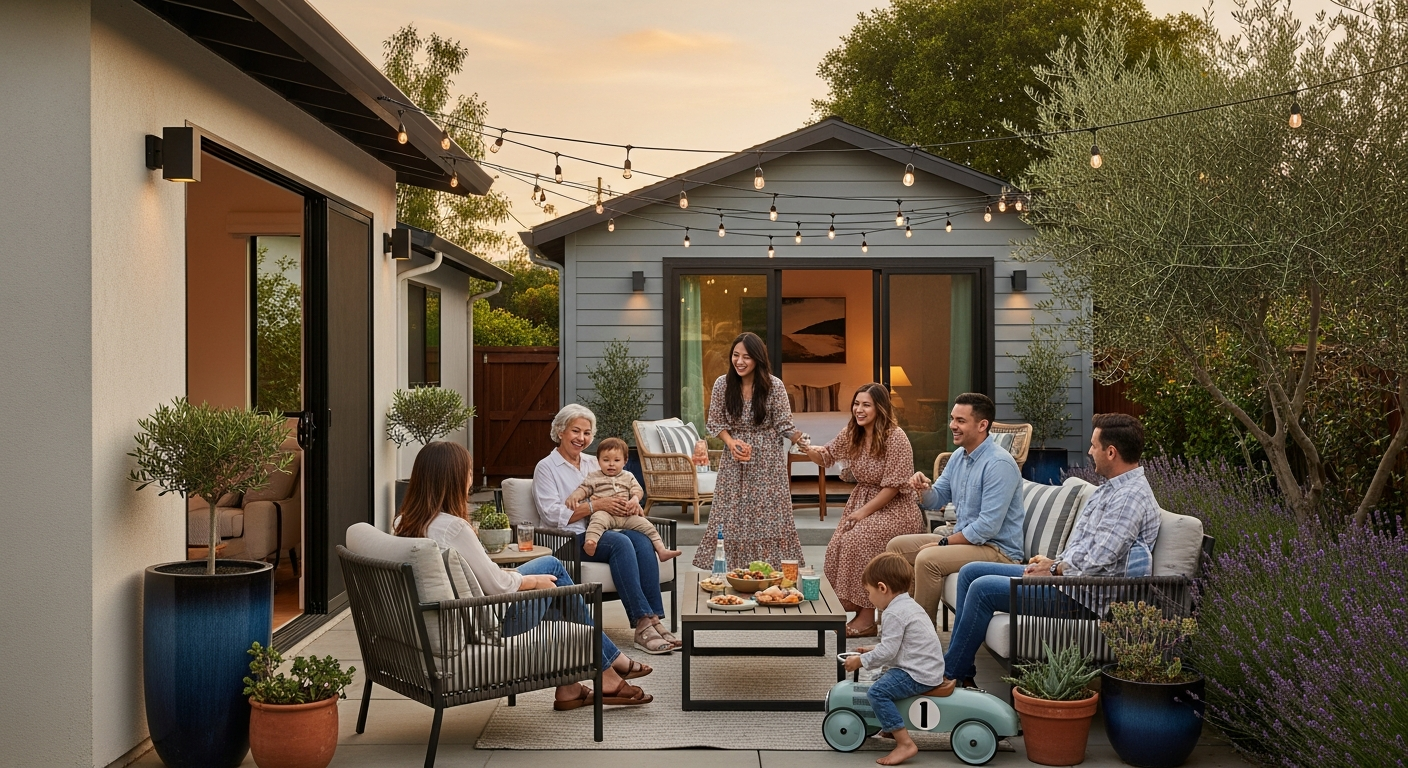
- Central patio or courtyard: A gathering space between the main house and ADU for meals, celebrations, and everyday socializing
- Shared garden: A vegetable garden, flower garden, or fruit trees that family members can tend together
- Play area: If grandchildren are involved, a shared play area visible from both the main house and ADU
- BBQ and outdoor kitchen: A shared cooking area that encourages family meals without crowding either unit's kitchen
- Walking path: A landscaped path connecting the two units that provides a pleasant transition between spaces
Balancing Shared and Private Outdoor Space
The most successful multi-generational properties clearly delineate which outdoor areas are shared and which are private. Use landscaping, different paving materials, or subtle fencing to create visual boundaries without feeling restrictive.
Accessibility Considerations for Multi-Generational ADUs
If the ADU is intended for aging parents or family members with mobility challenges, incorporate accessibility features from the design phase. Even if the initial residents do not have accessibility needs, building in universal design elements ensures the ADU remains functional as family needs evolve.
Key accessibility features to include:
- Zero-step entry from the pathway to the ADU
- 36-inch minimum door widths throughout
- Lever-style door handles and faucets
- Curbless shower with grab bars
- Comfort-height toilets
- Non-slip flooring throughout
- Adequate lighting in all circulation areas
- Emergency call button or smart home alert system
Financial Benefits of Multi-Generational ADU Living
| Benefit | Estimated Annual Savings |
|---|---|
| Avoided rent for family member | $18,000 to $36,000 |
| Shared childcare (vs. daycare) | $12,000 to $25,000 |
| Shared meals and groceries | $3,000 to $6,000 |
| Avoided assisted living costs | $48,000 to $96,000 |
| Property value increase | $100,000 to $300,000 (one-time) |
Frequently Asked Questions
What is the best ADU size for multi-generational living?
For a single aging parent, 500 to 700 square feet provides comfortable one-bedroom living. For a couple, 700 to 900 square feet with two bedrooms is ideal. For a family with children, aim for 1,000 to 1,200 square feet. The right size depends on the specific needs and preferences of the residents.
Should the ADU be attached or detached for multi-generational use?
A detached ADU provides the most privacy and independence, which is generally preferred for long-term multi-generational arrangements. An attached ADU is better for families where one member needs frequent assistance or where the lot size does not accommodate a detached structure.
How do we handle utility costs in a multi-generational arrangement?
The simplest approach is to install separate utility meters for the ADU. This way, each household is responsible for its own electricity, gas, and water usage. Alternatively, families can split a shared bill proportionally or include utilities in a below-market rent arrangement.
Do I need a rental agreement for family members living in my ADU?
While not legally required for family members, having a written agreement about expectations, financial contributions, and house rules can prevent misunderstandings. This does not need to be a formal lease, but a simple memorandum of understanding can be helpful.
Can multi-generational ADU living affect my property taxes?
Building an ADU will trigger a reassessment of the improvement (the ADU itself) but not the land or existing home under California's Proposition 13. The ADU's assessed value is based on its construction cost. Having a family member live there rent-free does not affect your tax status differently than having it sit vacant.
What if the multi-generational arrangement does not work out?
One of the biggest advantages of an ADU is flexibility. If the family arrangement changes, the ADU can be rented to a non-family tenant for rental income, used as a home office, or even potentially sold separately under AB 1033 in participating cities.
Ready to Start Your ADU Project?
Get a free consultation with our ADU experts and discover your property's potential.
Schedule Free ConsultationCommunication Tips for Multi-Generational ADU Households
Living in a multi-generational arrangement with an ADU on your property requires thoughtful communication strategies to maintain healthy relationships. California homeowners who successfully navigate shared living spaces consistently point to open, honest communication as the foundation of harmony.
Establishing Clear Boundaries Early
Before construction begins or move-in day arrives, sit down as a family to discuss expectations openly. Topics that should be addressed include visiting hours and drop-in policies, shared versus private outdoor spaces, noise expectations during different times of day, guest and overnight visitor policies, and responsibilities for shared property maintenance. Writing these agreements down, even informally, prevents misunderstandings later. Many families find that a simple shared document they can reference reduces tension considerably.
Regular Family Meetings
Schedule monthly or quarterly family meetings to check in on how the living arrangement is working. These meetings provide a structured opportunity to raise concerns before they become significant issues. Keep the tone positive and solution-oriented. Discuss what is working well alongside areas for improvement. This proactive approach prevents small frustrations from building into major conflicts.
Respecting Independence and Autonomy
One of the greatest advantages of an ADU over a shared-roof arrangement is that each household maintains its own independent living space. Respecting this independence means treating the ADU as a separate home, not an extension of the main house. Knock before entering. Call or text before visiting. Avoid monitoring the comings and goings of ADU occupants. These small courtesies preserve dignity and privacy for everyone involved.
Managing Shared Expenses
Discuss financial arrangements clearly and revisit them periodically. Common approaches include splitting utility costs based on square footage or usage, sharing yard maintenance costs equally, establishing a joint fund for property improvements that benefit both households, and agreeing on how property tax changes will be handled. For California homeowners, understanding how an ADU affects your property taxes and ROI is essential to these financial conversations.
Privacy Features for Multi-Generational ADU Living
Designing your ADU with privacy in mind from the start eliminates many of the challenges that multi-generational households face. These architectural and design features create comfortable separation while maintaining the closeness that makes multi-generational living rewarding.
Separate Entrances and Pathways
The ADU should have its own dedicated entrance that does not require walking through or past the main home's primary living areas. A separate pathway from the street or driveway to the ADU entrance gives occupants a sense of autonomy. Side gates or dedicated access points ensure that each household can come and go independently without disturbing the other.
Strategic Window and Door Placement
Position ADU windows so they do not directly face the main home's windows, particularly bedrooms and living areas. Clerestory windows (placed high on walls) bring in natural light without creating sightlines between the two homes. Frosted or textured glass in bathroom and bedroom windows facing the main home adds an extra layer of privacy. The orientation of doors should direct foot traffic away from private outdoor areas of both homes.
Sound Insulation
Invest in quality sound insulation for the ADU, especially on walls facing the main home. Double-pane windows, insulated exterior walls, and solid-core doors significantly reduce sound transmission between the two dwellings. If the ADU shares a wall with the main home (as in an attached ADU or garage conversion), adding resilient channel and additional drywall layers to the shared wall creates effective sound separation.
Independent Utility Connections
Wherever possible, provide the ADU with its own utility meters or sub-meters. Independent electrical panels, separate water heaters, and dedicated HVAC systems give ADU occupants control over their own comfort settings and eliminate disputes about energy usage. In California, new ADUs are typically required to have their own electrical panel, which provides a natural separation of systems.
Frequently Asked Questions About Multi-Generational ADU Living
What is the ideal ADU size for aging parents?
For aging parents, an ADU of 500 to 700 square feet typically provides comfortable living space. This size accommodates a bedroom, full bathroom, kitchen, and living area without feeling cramped. If wheelchair accessibility is needed, a slightly larger unit of 600 to 800 square feet allows for wider doorways (36 inches minimum), a roll-in shower, and adequate turning radius in all rooms. Single-story designs are strongly recommended to eliminate fall risks associated with stairs. Learn more about ADU floor plans and sizing for various needs.
How do multi-generational ADUs affect property value in California?
Multi-generational ADUs generally increase property values in California by 20% to 35% depending on the quality of construction, local market conditions, and the ADU's rental potential. Buyers increasingly view ADU properties as versatile investments that can serve family housing needs or generate rental income. In high-demand California markets like Los Angeles, San Diego, and the Bay Area, properties with well-designed ADUs sell faster and command premium prices compared to similar homes without ADUs.
Can I build an ADU specifically designed for a family member with disabilities?
Yes, and California law provides additional protections for ADUs designed for individuals with disabilities. You can incorporate accessibility features such as zero-threshold entries, wider hallways and doorways, roll-in showers, grab bars, lowered countertops, and accessible appliances. These modifications may qualify for tax deductions under federal disability accommodation provisions. Some California cities also offer expedited permitting for ADUs that will house individuals with documented disabilities.
What are the best ADU layouts for families with young children?
When grandparents or other family members with young children use an ADU, open floor plans with clear sightlines between the kitchen, living area, and any play space work best. Include childproofing features such as rounded countertop edges, safety locks on cabinets, and window guards. A small fenced outdoor area adjacent to the ADU gives children a safe play zone within view of the ADU's main living spaces. Consider a two-bedroom layout if children will sleep over regularly.
How do we handle mail and package delivery for the ADU?
Setting up a separate mailing address for the ADU simplifies mail and package delivery. Contact the United States Postal Service (USPS) to register the ADU as a distinct unit at your address (typically adding a unit number like "Unit B" or "1/2"). Install a second mailbox at the street. For packages, a dedicated delivery location near the ADU entrance or a shared package locker prevents confusion. Most California cities assign a separate address to permitted ADUs automatically during the permitting process.